

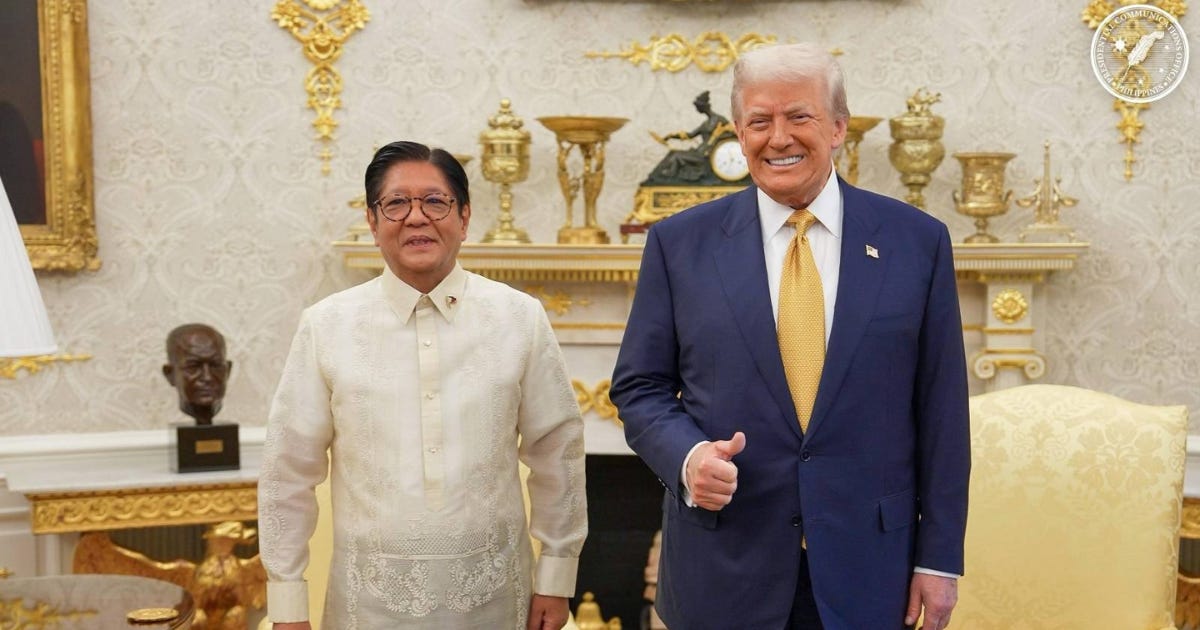
President Ferdinand Marcos Jr visited President Donald Trump last July 22, 2025 to negotiate the latest tariff imposed on Philippine exports to the US. Photo from Presidential Communications Office
By: Manuel Mogato | Published: July 25, 2025
Reading Time: 4 minutes
Washington – US President Donald Trump got more from the Philippines after he held talks with Philippine President Ferdinand Marcos Jr. at the White House.
Trump was able to convince Marcos to impose zero percent tariffs for certain American products while reducing by only 1 percentage point tariffs on Philippine exports from 20 percent.
Trump also secured wider access for cutting-edge missiles and drones in the Philippines as the two allies agreed to step up military cooperation to boost deterrence in the region.
Marcos was the first Southeast Asian leader granted an audience by Trump, but he failed to obtain substantial concessions from the United States.
“We managed to bring down the 20 percent tariff rate for the Philippines to 19,” Marcos said in an interview with the Philippine media delegation before heading back to Manila.
“Now, one percent might seem like a very small concession. However, when you put it in real terms, it is a significant achievement.”
The revised tariff rates placed the Philippines among the most competitively positioned Southeast Asian economies trading with the United States.
Subscribe to the API Newsletter
Bite-sized updates sent straight to your inbox.
Success!
First Name
Last Name
By signing up, you agree to our User Agreement and Privacy Policy & Cookie Statement. This site is protected by reCAPTCHA and the Google Privacy Policy and Terms of Service apply.
The Philippines has the second-lowest tariff rate in the region at 19 percent, with Singapore, which has a bilateral Free Trade Agreement (FTA) with the U.S., maintaining the lowest at 10 percent.
US tariffs for other Association of Southeast Asian Nations (ASEAN) countries range between 19 percent to 49 percent.
Next week, Marcos will deliver his fourth State of the Nation Address (SONA) before a joint session of Congress.
He could have boasted something if he got a better trade deal from the United States. Japan got a 15 percent tariff deal, and Indonesia also had a 19 percent tariff from 30 percent.
Under the trade deal, Marcos said that the Philippines will remove tariffs on American automobile imports.
“Because we have a tariff on American automobiles, we will open that market and no longer charge tariffs on that,” he added.
On the other hand, Marcos said the Philippines will increase imports of soy products, wheat, and pharmaceuticals.
“Medicines from the US will be cheaper,” he said.
“There’s still a lot of detail that needs to be worked out on the different products and the different exports and imports.”
The US is one of the country’s top trading partners with bilateral trade of over $23 billion in 2024. The Philippines also enjoys a slight trade surplus.
During his three-day visit to Washington, Marcos met with US State Department Marco Rubio, Defense Secretary Pete Hegseth, and the head of the Central Intelligence Agency, John Ratcliffe.
Marcos discussed with Ratcliffe on how to advance intelligence cooperation and enhance mutual efforts to address regional and global security challenges.
The security engagement underscores the enduring PH-U.S. alliance and the shared pursuit of peace, stability, and a rules-based international order.
The post Trade deal: Trump gets what he wanted appeared first on asiapacificinsights.com.