

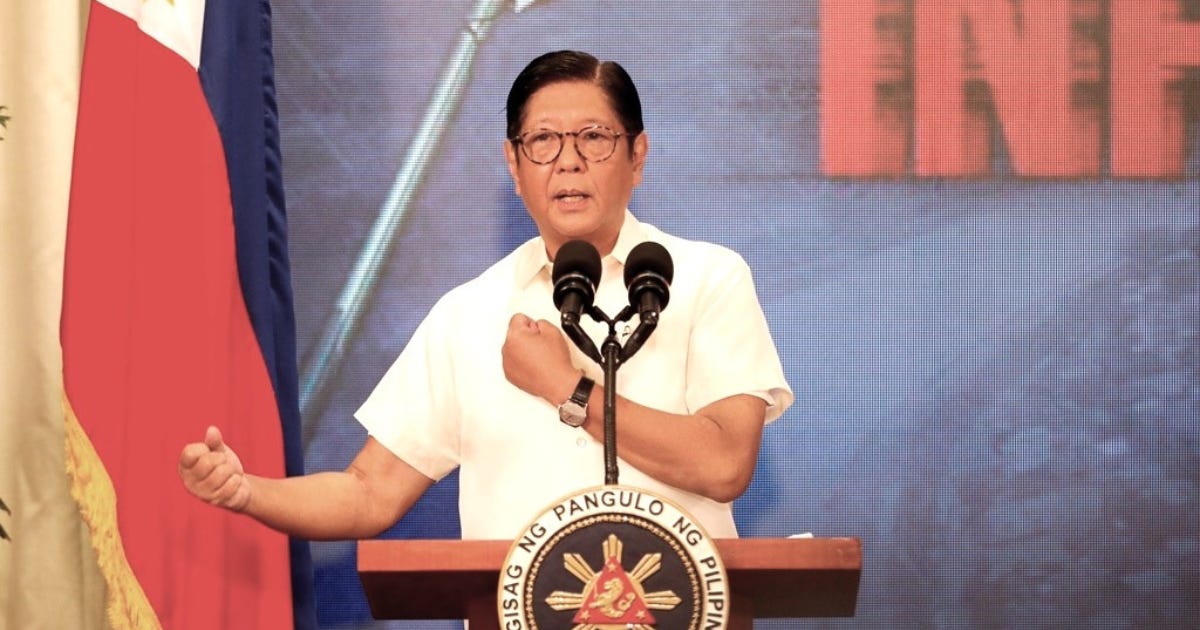
President Ferdinand Marcos Jr., at a palace briefing last September 15, 2025, encouraged the public to “make their feelings known” and said that if he would join them out in the streets were he not president. Photo from the Presidential Communications Office.
By: Manuel Mogato | Published: September 23, 2025
Reading Time: 4 minutes
There were rumors swirling of an attempt to unseat President Ferdinand Marcos Jr, weeks before the massive anti-corruption protest on September 21.
A source familiar with the plot said the head of a large Christian-denomination sect had met with a top Army commander days before the protest, convincing him to move against his commander-in-chief due to widespread corruption in the government.
The source said the church leader had promised to mobilize about 500,000 people to the Rizal Park in Manila on the day of the protest, and then ordered them to march to Malacanang Palace.
Subscribe to the API Newsletter
Bite-sized updates sent straight to your inbox.
Success!
First Name
Last Name
By signing up, you agree to our User Agreement and Privacy Policy & Cookie Statement. This site is protected by reCAPTCHA and the Google Privacy Policy and Terms of Service apply.
That would signal the military to announce its withdrawal of support from the Marcos administration, a move similar to what the late Armed Forces chief of staff, General Angelo Reyes, did in January 2001, forcing then President Joseph Estrada to resign from his office.
The source said there was only one problem. He said the church leader wanted Vice President Sara Duterte-Carpio to take over once Marcos is removed.
He said the Army commander turned down the church leader’s proposal. Instead, the Army commander suggested a revolutionary government, made of a 30-man civilian-military junta.
Two members of the Roman Catholic clergy were reportedly invited to join the junta, but had been warned by their superiors not to take part in any extra-constitutional means to remove the president.
The source said the junta would also arrest and jail senators, congressmen, and other public officials implicated in the anomalous infrastructure projects which defrauded the government of billions of pesos.
The meeting ended without an agreement, the source added, but the church leader and a retired general identified with the previous government continued to talk to the Army commander and convinced him to stage a mutiny and install the vice president.
The source said the Army commander was reluctant because the United States would not be happy with the possible rise of the vice president in a regime change.
On Friday, the source said the church leader and Army commander had met again. This time, the Army commander firmly rejected the church leader and retired general’s proposal to install Sara Duterte.
A day before the September 21 protest, the source learned the church leader ordered his followers to stand down, prohibiting them from joining the mass actions in Luneta and on EDSA.
The mutiny was averted but violence outside the presidential palace when protesters wearing masks threw stones and molotov bombs at unarmed police crowd control units.
The source said it was not known if the mob attack on Mendiola and at the foot of Ayala bridge was part of the planned mutiny.
A politician and a lawyer were believed to be behind the violent protest.
The unruly protesters had tried to stage violent actions similar to what had happened to Nepal and Indonesia.
The source said there was a plan by rioters to burn down the Presidential Palace, the military camp, and the homes of lawmakers and a private contractor.
The source said the threat of an Army mutiny is still a possibility if the government would not move fast to hold corrupt lawmakers and officials accountable.
The Philippines is no stranger to military mutineers. Two only succeeded since 1986 and nearly a dozen had failed.
President Marcos should act fast to defuse building tension and ensure the loyalty of the Armed Forces.
Last week, he held a dialogue with the Association of Generals and Flag Officers (AGFO) to assure them corrupt officials and lawmakers would be jailed.
Marcos should also talk to disgruntled troops to avoid a potential destabilization attempt.
The post Ferdinand Marcos Jr nearly lost his presidency during the September 21 anti-corruption protest appeared first on asiapacificinsights.com.