
Strengthening the US’ first-island-chain

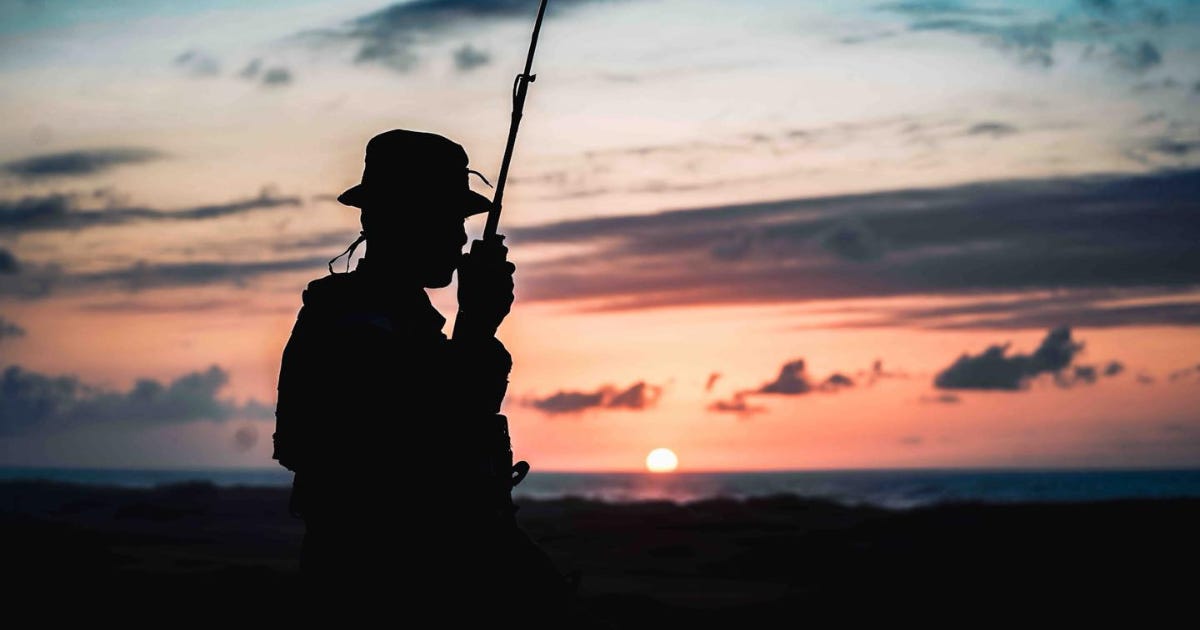
An AFP personnel keeping watch during the AJEX 09-2025 in La Paz Sand Dunes, Laoag, Ilocos Norte. Photo by LTC Salgado from AFP Public Affairs Office.
By: Manuel Mogato | Published: November 29, 2025
Reading Time: 5 minutes
China has built several artificial islands in the South China Sea, putting up a barrier to keep its rival power, the United States, away from its shore.
It’s a buffer zone. The man-made islands form China’s first island chain, a Cold War concept it adopted from the United States, which was designed to contain Russia and China in the early 1950s.
But Washington’s first island chain extends from the Kuril Islands in the north down to Borneo in the South, including Japan, Taiwan, and the Philippines.
These first island chains are imaginary lines of defense for both China and the United States, heightening tensions in the region as their rivalry intensified.
Now that China had built man-made islands in the South China Sea, the US has also been hardening its own first island chain, reorganizing its Marine Expeditionary Forces in the Pacific to form littoral regiments and deploy them in strategic chokepoints in the region.
In the Philippines, for instance, small teams of US Marines were stationed in Batanes, Cagayan, Ilocos Norte, Zambales, and in Palawan to monitor Chinese presence in the West Philippine Sea and the narrow straits between self-ruled Taiwan and the Philippines. (Also read: The Philippines develops a new defense strategy: “Tatak Kapuluan”)
These teams are deployed in strategic chokepoints, armed with Marine Air Defense Integrated Systems (MADIS) and anti-ship Navy-Marine Expeditionary Ship Interdiction System (NMESIS), protecting maneuver forces.
The presence of US Marines in strategic chokepoints increases the Philippines’ deterrence capability and will likely prevent China’s amphibious assault on Taiwan. (Also read: Philippines, United States start ‘joint military operations” next year)
Recently, the US Marines started deploying several 40-foot container vans to a Japanese Self-Defense Forces base on a tiny Yonaguri island, just 70 miles east of Taiwan, the closest it gets to a potential conflict zone.
Subscribe to the API Newsletter
Bite-sized updates sent straight to your inbox.
Success!
First Name
Last Name
By signing up, you agree to our User Agreement and Privacy Policy & Cookie Statement. This site is protected by reCAPTCHA and the Google Privacy Policy and Terms of Service apply.
The container vans contain humanitarian supplies and equipment, including food, medicines, part of a large-scale US-Japan drill, which saw the deployment of a Typhon missile launcher on Japanese soil.
Washington has pulled out the Mid-Range Capability (MRC), but has quietly occupied tiny islands close to Taiwan, co-locating with Japanese defense forces.
The creation of Marine Littoral Regiments and deployment on major, strategic choke points in the region is seen as part of the US efforts to prepare for a potential conflict with China.
Many US generals had predicted that China would launch an invasion of Taiwan in 2027, the 100th anniversary of the creation of China’s People’s Liberation Army (PLA), to unify what it considered a renegade province with the mainland. (Also read: Preparing for a humanitarian crisis if conflict erupts in Taiwan)
It’s the last piece of territory that China needed to annex after seizing Tibet in 1951 while the British returned Hong Kong in 1997 and Portugal relinquished control over Macau in 1999.
Apart from strengthening its own first island chain, the US has also kept a constant presence in the South China Sea, increasing its freedom of navigation patrol operations with allies, like Australia, Japan, and the Philippines.
In early November, the USS Nimitz battle group sailed near Bajo de Masinloc with a Japanese destroyer and two Philippine guided-missile frigates, challenging China’s claim on a disputed rocky outcrop.
A week after the USS Nimitz left and sailed back to its homeport in the US West Coast, another battle group, USS George Washington, has entered the South China Sea from its homeport in Japan.
The presence of an US aircraft carrier in the disputed waters demonstrated Washington’s resolve not only to deter Beijing but prevent it from its illegal, coercive, aggressive, and dangerous behavior toward weaker and smaller neighbors, like Malaysia, the Philippines, and Vietnam – all claimant-states in the South China Sea.
The constant carrier presence in the South China Sea could also be part of what Defense Secretary Pete Hegseth had announced in Kuala Lumpur in late October about the creation of Task Force Philippines.
Washington has not fully explained in details the size and scope of the Task Force and why it is needed other than deterrence.
Whether the presence of a carrier strike group in the South China Sea is part of the Task Force, and the reorganization of the US Marine Expeditionary Forces constitute US commitment to its allies to keep its presence in the region and maintain the balance of power.
But the United States cannot do it alone.
Its allies should share the burden of keeping the region stable and secure and prevent other powers from changing the status quo.
Sailing together with the US and providing access to US troops, equipment, and logistics would help Washington harden its first island chain, long forgotten after the Cold War.
The post Strengthening the US’ first-island-chain appeared first on asiapacificinsights.com.