
India recalibrates Afghanistan policy as Kabul clashes with Islamabad

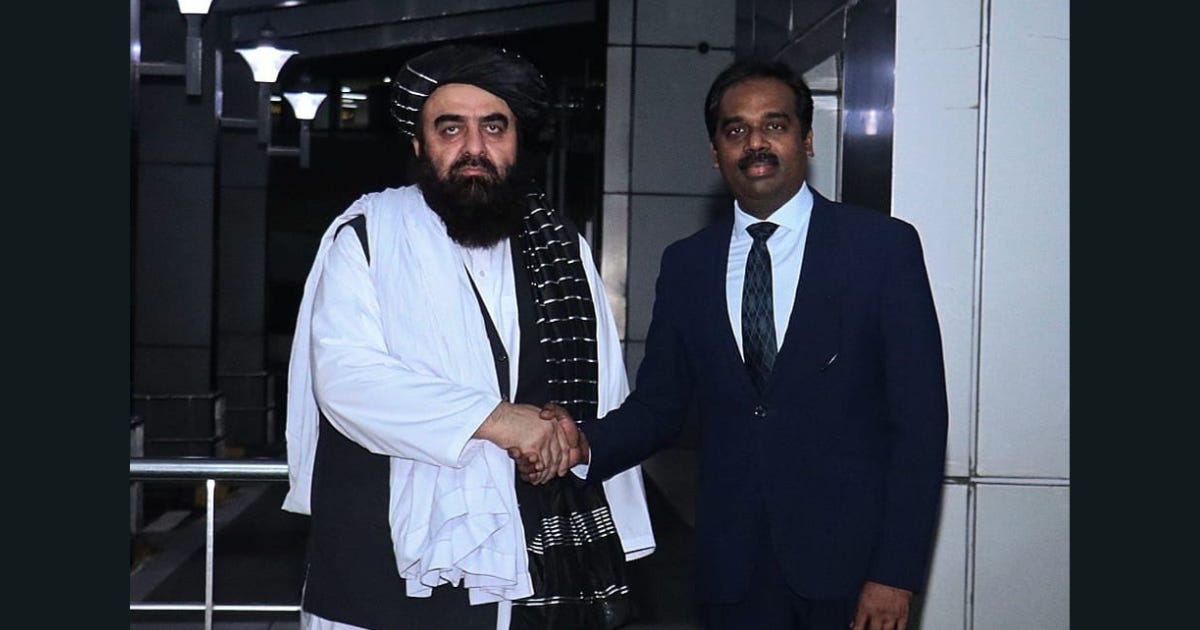
Afghan Foreign Minister Mawlawi Amir Khan Muttaqi arrived in New Delhi on 9 October, to discuss Aghanistan-Indian relations and other regional issues. Photo from India’s Ministry of External Affairs.
By: Pirzada Shakir | Published: October 30, 2025
Reading Time: 7 minutes
New Delhi — While Afghan Foreign Minister Amir Khan Muttaqi was in New Delhi exploring deeper ties with India, deadly exchanges were taking place across the Durand Line. Pakistan and Afghanistan traded heavy artillery fire, leaving dozens dead on both sides.
As Kabul’s relations with Islamabad descended into open conflict, Afghanistan appeared to be drawing closer to Pakistan’s arch-rival – India. The timing puts spotlight on a striking geopolitical contrast: one neighbour locked in gunfire, the other engaging in handshake diplomacy.
Amid this turbulence, India is recalibrating its approach to Afghanistan, expanding diplomatic and economic engagement just as Pakistan–Afghanistan tensions reach a dangerous peak.
Muttaqi’s visit – his first to India since the Taliban’s return to power in 2021 – marks a significant inflection point in South Asia’s evolving power dynamics. New Delhi seeks to shape outcomes in a rapidly shifting regional landscape.
Subscribe to the API Newsletter
Bite-sized updates sent straight to your inbox.
Success!
First Name
Last Name
By signing up, you agree to our User Agreement and Privacy Policy & Cookie Statement. This site is protected by reCAPTCHA and the Google Privacy Policy and Terms of Service apply.
Muttaqi arrived in India on October 9 on a UN-mandated travel exemption. He spent a week in Delhi discussing the future of India–Afghanistan relations with Foreign Minister S. Jaishankar and other top Indian officials.
While India has not yet officially recognized the Taliban regime, it announced the upgrading of its Kabul mission from a technical office to a full-fledged embassy.
New Delhi also pledged expanded humanitarian and infrastructure assistance to Afghanistan, particularly in healthcare, education, and public works.
India’s External Affairs Minister reiterated “India’s long-standing friendship with the Afghan people and highlighted the deep-rooted cultural and historical ties binding the two nations.”
Both sides also discussed ways to further strengthen “cooperation in sports, especially cricket, to advance cultural interactions,” according to India’s Ministry of External Affairs.
Former Indian Ambassador to Afghanistan Amar Sinha underlined the recent developments as a continuation of India’s “consistent policy” towards Kabul.
“India–Afghanistan relations have one constant, and that is India’s support to the State of Afghanistan – which has meant standing with and behind Kabul,” he said.
Sinha said: “I see the outreach to the new regime in Kabul as a continuation of that policy. No doubt it would be interpreted differently in different capitals.”
On the question of recognition of the Taliban government in Afghanistan, he added, “Regional consensus is tilting towards engagement even if formal recognition has to wait.”
Security calculus: Reorientation amid tensions
India’s recalibration comes as Pakistan–Afghanistan ties deteriorate into open conflict across the Durand Line dividing the two countries. Recent border clashes – the first of their kind since 2021 – resulted in dozens of fatalities, with each side accusing the other of cross-border provocations and militant support.
Afghan officials, including Muttaqi, claimed that 58 Pakistani soldiers were killed. Pakistan disputed the figure, stating that 23 of its soldiers died and 29 were wounded, while claiming to have killed over 200 Taliban fighters during the clashes.
The two neighbours agreed to an immediate ceasefire on October 19, following week-long border clashes, during peace talks mediated by Qatar and Turkiye in Doha.
Pakistan has long blamed Kabul for harboring Tehreek-i-Taliban Pakistan (TTP) militants. Recent Pakistani airstrikes deep inside Afghanistan escalated the standoff, prompting strong Afghan reprisals.
According to Abdul Basit, Senior Associate Fellow at Singapore’s S. Rajaratnam School of International Studies, “historically, Afghanistan–Pakistan relations have always been tense – conflict-prone and rooted in ethnicity, borders, proxy wars, and terrorism. What we are seeing now is unprecedented in scale.”
He noted that Pakistan’s “patience with the Taliban has run out,” leading to a complete breakdown of trust between the two capitals.
Adding a note of caution, Walter Ladwig, Senior Associate Professor in International Relations at King’s College London said that “India’s principal risk is overestimating the Taliban’s willingness, or capacity, to deliver on security assurances.”
“India must hedge against the possibility that anti-India groups once again find sanctuary in Afghanistan,” Ladwig warned. “There is also a reputational cost: deeper engagement could be perceived as tacit recognition of a regime with which India has fundamental value differences.”
Strategic implications
India’s bolstered engagement is being watched closely by Islamabad, which for decades enjoyed privileged influence in Kabul. Analysts see New Delhi’s pragmatic outreach as exploiting the widening Taliban–Pakistan rift.
India now seeks to preserve its strategic interests, protect previous investments, and prevent a security vacuum that could spill over into South Asia.
New Delhi’s investments and development assistance in Afghanistan amount to over $3 billion across more than 500 projects in all 34 provinces. Both sides have emphasised mutual guarantees, while Afghanistan has reaffirmed it will not allow its soil to be used for terrorism against India – a long-standing concern in New Delhi’s security calculus.
“The biggest strategic risk for India,” warned Michael Kugelman, Director of the South Asia Institute at the Woodrow Wilson Center, “is if it moves too quickly to expand its presence in Afghanistan without adequate security assurances. That could expose Indian nationals and assets to terrorist threats.”
Kugelman added that India’s deeper engagement is also driven by the desire to preserve its long-term influence in Afghan public perception.
“I do think that one of the many reasons why India has decided to engage more deeply with the Taliban,” he said, “is to be able to build on its legacy as a close partner of Afghanistan, as a friend of the Afghan people. The Afghan public still views India as a dependable source of assistance, and New Delhi wants to continue to be able to tap into that.”
At the same time, he said that he may not argue that “India hasn’t really lost the ground it had occupied for many years prior to the Taliban coming back to power.”
“We saw fairly soon after the Taliban returned a level of readiness on the part of India to engage with the Taliban, and particularly because Pakistan found itself on the defensive given its tensions with the Taliban,” Kugelman said.
Basit said Pakistan’s earlier assumption that Taliban rule would strengthen its hand in Kabul has “backfired.”
“It was a strategic miscalculation,” he observed. “Pakistan thought the Taliban’s return would resolve all its problems. That didn’t happen. Goodwill has ended, leverage has eroded, and today there’s no love lost between Kabul and Islamabad.”
He added that this rupture has given India “an opening” it could not have imagined a few years ago.
“Now the western border is hot and Pakistan is overstretched. That, in a sense, is a blessing for India. What was once India’s two-front problem has become Pakistan’s two-front problem.”
Sinha, however, framed New Delhi’s outreach through a values-driven perspective.
“Indian support for Afghan sovereignty, concern for her people, and responding to their humanitarian and developmental needs will provide the needed ballast.”
Ladwig noted that while reopening the embassy provides India “a diplomatic foothold,” real influence will require consistency.
“India retains the advantage of a substantial development footprint and a reputation for non-intrusive partnership,” he said. “Recovering lost influence will require sustained and carefully calibrated engagement, not symbolic gestures alone.”
Regional context and the China factor
Basit believed that India’s accelerated outreach to Kabul “has been fast-tracked because of India–Pakistan tensions.”
“The trajectory was already there,” he said, “but what might have happened in 2026 or 2027 is happening in 2025 due to the worsening Pakistan–India dynamic,” referring to recent tensions between the two rival nations.
He also observed that Pakistan’s eroded leverage in Kabul has created “a kind of two-front situation” for Islamabad. “Now Pakistan is overstretched between its eastern and western borders – that’s a blessing for India,” Basit said.
Kugelman noted that the China factor in Afghanistan deserves a more nuanced look.
“China is actually not that present in Afghanistan,” he said. “It has close ties with the Taliban and the Taliban wants to do business with Chinese companies, but China is not very present. Beijing and many other neighbouring countries that otherwise would like to be more present in Afghanistan worry a lot about security and terrorism risks.”
He added that India’s Afghan strategy is now less shaped by rivalry with Beijing.
“China and India have quietly pursued a modest détente,” Kugelman said. “That suggests India’s plans in Afghanistan would not necessarily be shaped with an eye to China as they might have been several years ago.”
Ladwig added that while Beijing’s growing economic and security footprint “will complicate India’s efforts to reassert itself,” it also offers diplomatic space.
“China can offer resources the Taliban craves,” he said, “but that also creates space for India to position itself as a complementary, less coercive partner.”
Opportunities and risks
The re-engagement could mark the beginning of a wider South Asian realignment, with New Delhi betting that pragmatic ties with Kabul could bring both strategic depth and economic dividends.
Basit said that Pakistan will remain “the factor” in India’s Afghan calculus.
“You can’t see India–Afghanistan relations without factoring in Pakistan,” he said. “Realpolitik doesn’t allow that. Pakistan remains an important variable in India’s Afghan policy – in fact, the factor.”
Ladwig warned that India’s policy, though pragmatic, is inherently fragile.
“This is a pragmatic policy, but a fragile one,” he said. “India’s outreach is contingent on a minimum level of stability along the Afghanistan–Pakistan frontier. If border tensions escalate or TTP activity surges, Delhi’s diplomatic space will narrow quickly.”
He concluded that sustaining this approach will depend on India’s ability to remain agile in a volatile environment.
The post India recalibrates Afghanistan policy as Kabul clashes with Islamabad appeared first on asiapacificinsights.com.