


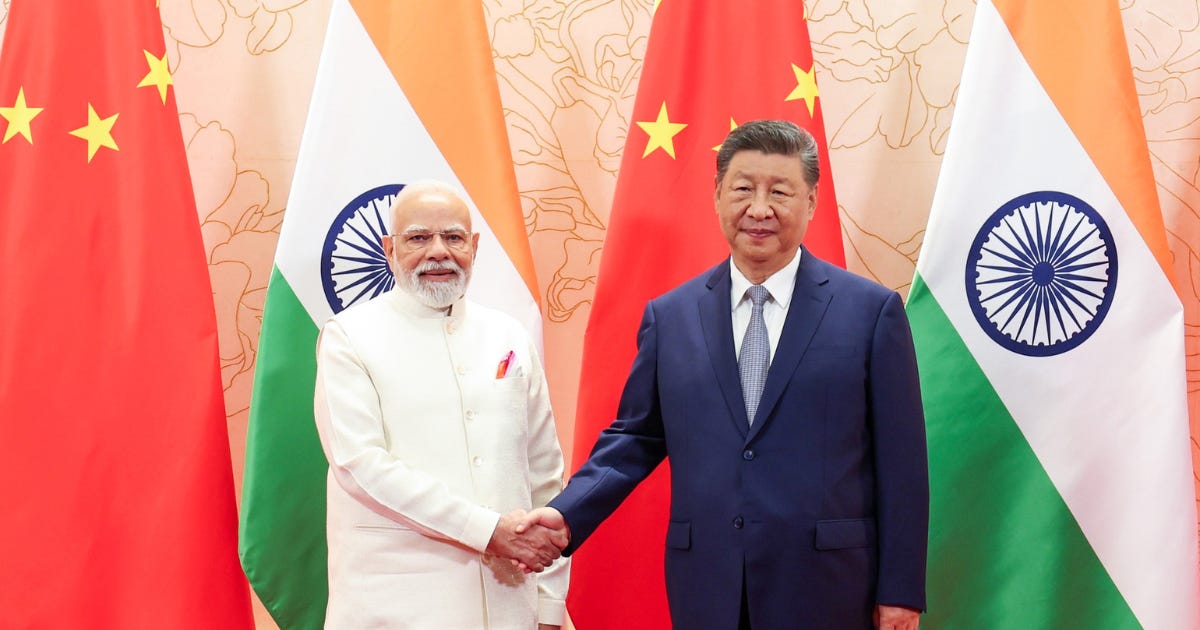
Prime Minister Shri Narendra Modi and President Xi Jinping at the sidelines of the Summit of the leaders of the Shanghai Cooperation Organization in Tianjin, China, 31 August 2025. Photo from PMIndia website.
By: Pirzada Shakir | Published: September 3, 2025
New Delhi — When Indian Prime Minister Narendra Modi stepped forward to greet China’s top diplomat in New Delhi last week, the optics were striking. Smiling handshakes, pledges of “new momentum,” and a call for “border peace” defined the meeting.
Just a few years ago, ties were in freefall after the bloody clashes ensued in Galwan Valley along their Himalayan frontier. Now, amid growing turbulence in the global economy, the two Asian giants are edging toward a thaw in ties.
US President Donald Trump’s sweeping tariff wars are unsettling global supply chains and roiling investor confidence. Long docked into strategic rivalry, New Delhi and Beijing find themselves with aligned incentives. By coordinating, experts say, at least tactically, they can resist US led economic disruption and posture as defenders of Asian and Global South interests.
“India has to be closer to China because they don’t have a choice,” said Professor Cedomir Nestorovic, Director of the ESSEC & Mannheim EMBA Asia-Pacific. (Also read: India’s tightrope: Balancing BRICS ambitions amid rising US tariff threats)
“If the Western alternative represented by the United States is missing, then at least for the short term, India must lean toward China despite many animosities.”
Senior foreign affairs expert Robinder Sachdev, President of Imagindia Institute, an Indian think tank, struck a cautious note: “It’s too early and too premature to talk about a strategic alliance between India and China. At best, what we could see is, inch by inch, a working relationship developing between the two countries in multiple areas where there could be cooperation, and in several of the areas where we have differences.”
Such tactical alignment, some experts warn, could hurt India’s standing as Washington’s key partner in the Indo-Pacific. “This development is a concern, and certainly undermines the importance given to India by the United States and the West in the Indo-Pacific region vis-a-vis competition with China,” added Aryan D’Rozario, Associate Fellow at Chair on India and Emerging Asia Economics (CSIS).
Driven by economic disruption
At the same time, analysts point out that the driving force behind this unexpected convergence is not “strategic trust” but economic disruption. Trump’s tariff offensive is reshaping trade flows in ways that leave both India and China scrambling for room to maneuver.
“Trump’s tariffs disrupt China’s ability to sell freely into the US market and also make it harder for India to compete in or access that same market,” Sanjay Kumar, an associate professor in economics at Delhi University told Asia-Pacific Insights. (Also read: India developing deep-strike weapon, challenges US bunker-buster ordnance dominance)
“This shared disruption pushes both countries to adjust in ways that bring them into closer, though cautious, cooperation.”
Lt. General (Retd.) Sanjay Kulkarni, senior defence expert based in India, however, cautioned against overstating the role of tariffs in driving the thaw. “The Chinese relationship must not be seen as a rebound to what is tariff,” he said.
“Because of the hardships imposed by the USA on India, we are getting closer to China. But these two things are disassociated.”
For decades, India and China have walked a thin line between cooperation and confrontation. That balance shattered in 2020, when soldiers from both sides clashed in Galwan, the bloodiest encounter in over forty years. The violence left scars that went beyond the battlefield: military deployments along the frontier swelled, and mistrust seeped into public debate and political rhetoric on both sides.
Now, analysts say border management, not border resolution, has become the guiding principle. India’s National Security Adviser Ajit Doval’s recent meeting with Chinese Foreign Minister Wang Yi in New Delhi emphasised “peace and tranquility” along the frontier as a precondition for wider dialogue.
Despite border disputes and strategic competition, India continues to import Chinese machinery, electronics, and raw materials at record levels. For Beijing, US tariffs have tightened the need for stable trading partners across Asia. For India, diversifying trade relationships helps cushion the blow of higher prices and global volatility.
Seeking collective leverage
Trump’s return to aggressive protectionism has heightened this urgency. Asian markets have watched nervously as tariff measures ripple across industries from semiconductors to solar panels. For Delhi and Beijing, collaborating in institutions like BRICS, the G20, and the Asian Infrastructure Investment Bank provides a measure of collective leverage.
“The recent thaw between India and China, spurred by Trump’s aggressive tariff policies, is best understood as an exercise in crisis management, not genuine strategic realignment,” Prof. Kumar said.
“The harsh trade barriers imposed by Washington have jolted both economies, compelling them to seek tactical relief in each other’s markets and cautiously reopen frozen diplomatic channels,” he added. General Kulkarni added a note of pragmatism: “There is no substitute for talks. It is better to do jaw-jaw than war-war. This is the first step, a baby step, but one that could help sustain the process.”
On the global stage, India and China often strike the same pose, speaking as voices of the Global South and calling for fairer rules in global finance and development. Together, they represent almost 40% of the world’s population and are the fastest-growing economies, a weight hard to ignore.
But beneath that surface solidarity, the fault lines are clear. India leans on its partnership with the US and its allies in the Quad, casting itself as a pillar of Washington’s Indo-Pacific vision. China, meanwhile, doubles down on its ties with Pakistan and extends its reach across the Indian Ocean through its Belt and Road Initiative.
“It [Trump’s tariff war] certainly complicates US and European hopes of India as a balancing counterweight to China,” Prof. Nestorovic said.
“Trump looked only at tariffs, not the security dimension. But if you are losing India, what do you have in the Indian Ocean? Can you control Pakistan? Can you control other countries? I’m not so sure.”
“India’s relationship with the United States stands on its own merits,” said D’Rozario. “I don’t think India has ever characterized its partnership with the United States as ‘serving as a balancing counterweight to China’. India is a growing market for American products, and has engaged with the US on advancing defense, energy security, critical minerals exploration, and technology cooperation.”
Elephant in the room
Sachdev said that Trump’s tariff war cannot be ignored in this context: “It is the elephant in the room, nobody can miss it. The tariffs are not just a role, they are the context.”
He added that about a year ago, on the sidelines of BRICS in Kazan, India and China had decided to “start normalizing relations step by step, and that process was progressing”. The cautious rapprochement is being closely monitored around the world. Washington worries that India’s hedging may dilute its role as what many see as a “balancing counterweight” to China.
Russia, meanwhile, welcomes the moment. With its own ties to Beijing unshaken, Moscow views India’s outreach as reinforcing its long-promoted “multipolar world order.”
European capitals and Tokyo are more ambivalent, fearing that even temporary cooperation between Asia’s two great rivals could blunt Western strategies aimed at containing China’s rise.
Tokyo sees Russia-India-China trilateral (RIC) as a potential platform for anti-Western or anti-Japan cooperation. Despite the recent smiles, old suspicions linger. India watches warily as China’s economic reach stretches across Asia, while Beijing bristles at New Delhi’s comfort with Washington.
The mistrust runs deeper, etched into the frozen Himalayan border, sharpened by naval rivalry in the Indo-Pacific, and reinforced by competing bids to lead the developing world.
Marriage of convenience
China and India’s current closeness in 2025 is less a love story than a marriage of convenience. With Trump’s tariffs jolting global trade, both governments are improvising. For Modi, a limited thaw offers breathing space; for Xi, it provides a buffer against unrelenting US pressure. (Also read: The price of doing business with Trump’s America)
The Tianjin SCO Summit may bring more warm words and policy coordination. However, analysts note, should US policies shift, or should tensions flare again on the Himalayan frontier, India and China could just as easily slip back into hostility.
Indian Prime Minister Narendra Modi reached China on Saturday to attend SCO Summit, for the first time in over seven years. Following his meeting with Chinese President Xi Jinping on Sunday, India’s Ministry of External Affairs said that both leaders highlighted the need to strengthen people-to-people ties through direct flights and the resumption of Kailash Mansarovar Yatra.
“They reaffirmed that the two countries were development partners and not rivals,” the statement added.
Prime Minister Modi also underlined the importance of “peace and tranquility” on the border areas for continued development of bilateral relations. He also noted that India and China both “pursue strategic autonomy, and their relations should not be seen through a third country lens.”
Meanwhile, Russian President Vladimir Putin will be in New Delhi, for the forthcoming reciprocal 23rd annual bilateral summit with Prime Minister Narendra Modi, likely in December.