
Chinese navy, coast guard collide with reality

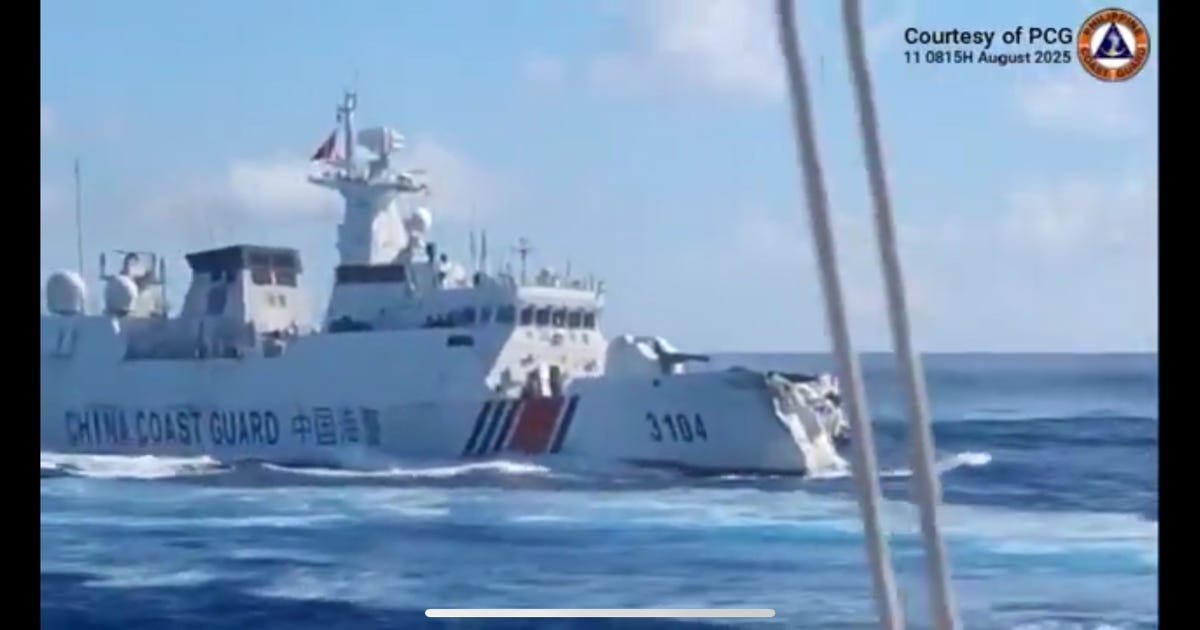
A still image from the video taken by the Philippine Coast Guard of the collision between the PLA Navy 164 and the China Coast Guard (CCG) 3104 on August 11.
By: Rodney Jaleco | Published: August 19, 2025
Reading Time: 5 minutes
WASHINGTON D.C. — The collision between Chinese navy and coast guard ships off Panatag Shoal (Scarborough Shoal) earlier this week hinted at flaws in their command structure and raised the question of how it may be permeating China’s military modernization.
A China Coast Guard (CCG) cutter and People’s Liberation Army-Navy (PLAN) guided-missile destroyer were chasing off a smaller but more agile Philippine Coast Guard (PCG) vessel from the vicinity of Panatag Shoal on the morning of Aug. 11 when they inexplicably ran into each other’s path, severely damaging the CCG’s bow, leaving her unseaworthy and dead in the water.
The whole incident was recorded from the PCG’s BRP Suluan. The images quickly went viral, humiliating Beijing which has never officially acknowledged the collision and raised serious doubts about China’s abilities in the high seas it’s been struggling to dominate.
The BRP Suluan, a 146-foot, 320-ton multi-role vessel (MRRVs) acquired through Japanese aid in 2017, was part of a small flotilla that included a Bureau of Fisheries supply boat delivering fuel and supplies to a group of Filipino fishermen around Panatag Shoal (the shoal itself has been blocked by China since 2012 although a 2016 agreement set rules that purportedly gave Filipinos “fishing rights” but that’s been largely ignored).
Barely a day after the collision, the Burke-class guided missile destroyer USS Higgins and Litoral Combat Ship USS Cincinnati appeared within 30 miles off Panatag Shoal and were challenged by the Chinese. The ships however sailed through, invoking Freedom of Navigation.
Subscribe to the API Newsletter
Bite-sized updates sent straight to your inbox.
Success!
First Name
Last Name
By signing up, you agree to our User Agreement and Privacy Policy & Cookie Statement. This site is protected by reCAPTCHA and the Google Privacy Policy and Terms of Service apply.
Panatag Shoal, about 120 miles west of Luzon, straddles the strategic sea lanes of the South China Sea, traversed by vessels bearing about a third of the world’s trade. The US, Japan, Australia and New Zealand expressed alarm over the “dangerous and unprofessional conduct of Chinese vessels near Scarborough Shoal involving the Philippine Coast Guard,” as they called for de-escalation and restraint.
“This is a learning experience for the People’s Republic of China,” said Commodore Jay Tarriela, stressing that “For so many years, we have been reminding them to stop dangerous maneuvers, to stop risky blockings, to adhere to the (anti-)collision regulations because if there is a very high chance of miscalculation, this kind of collision incident would happen.”
He seemed to echo a growing consensus here that China, in the seas at least, still has much to learn and change. Retired US Navy Capt. Scott Smith wrote in a US Naval Institute journal about China’s “seamanship aspect”. The collision, he averred, casts doubt on the Chinese command and control structure, and the delineation of authority and responsibility between commanding officers and political commissars.
Maritime experts questioned why the Chinese guided missile destroyer Guilin continued to pursue the BRP Suluan for over an hour after seeing the severity of the damage on the Chinese Coast Guard ship and likelihood of casualties when the instinctive mariner’s response would be to aid the stricken.
“Is this a case in which the political desire exceeded the ship handling competence of those involved?” Capt. Smith asked, “Were there two separate chains of command – one PLAN and one CCG?”
We thus have to ask how much of this alleged dichotomy between parallel and possibly competing C&C structures are reflected on China’s military modernization. They’ve allocated $233 billion for defense this year but some say their actual expenditures – including for “power parity” – may actually amount to over $700 billion.
And yet this week’s incident in Panatag Shoal suggests China – in the contest of the world’s top military powers – may still be nothing more than a paper tiger.
The PLA Navy now has three aircraft carriers and enjoys a slight numerical edge over the US Navy. Observers say it will take them several more years to acquire the requisite skills and proficiency for carrier operations. And yet they seem eager to flex what they believe are well-formed muscles in the West Philippine Sea.
But what happened to their ships this week could well be a metaphor for China – in the process of pursuing a crafty quarry, they collided with reality.
The post Chinese navy, coast guard collide with reality appeared first on asiapacificinsights.com.